Can Technology Make a Message Feel More Human? The Design Behind Personalization That Actually Connects
We tend to assume technology flattens our messages into something generic. But the right design does the opposite. Here's the semi-technical story of how personalization can make a digital message feel unmistakably human — and how to use it.
Can Technology Make a Message Feel More Human? The Design Behind Personalization That Actually Connects
There's a quiet assumption most of us carry about technology and feeling: that the two pull in opposite directions. That a handwritten note is warm and a digital one is cold. That the more a tool automates, the more it flattens what we're trying to say into something anyone could have sent to anyone.
It's an understandable assumption. We've all received the auto-generated "Happy Birthday!" that clearly cost no one a single thought. But it mistakes a design failure for a law of nature. Technology doesn't have to make our messages more generic. Designed with the right intentions, it can do the opposite — it can make it easier to say the specific, true, unrepeatable thing you actually mean. The difference isn't the presence of technology. It's what the technology is built to help you do.

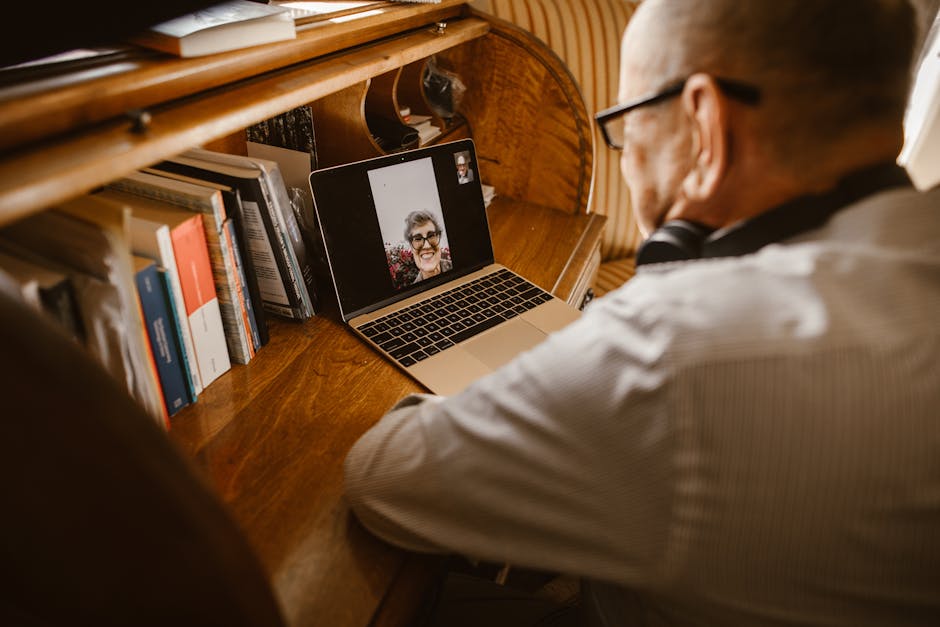
Behind every meaningful digital message is a stack of choices — human and technical. Photo by Mikhail Nilov via Pexels.
Nugget: Technology doesn't decide whether your message feels human. It decides how easy that is for you to pull off.
What actually makes a digital message feel personal?
Not the medium. The attention.
A message feels personal when the person receiving it can tell it was meant for them — that someone paused, pictured them specifically, and chose accordingly. That perception of being known is not a nicety; it registers deep in the brain. Neuroscience research has shown that feeling understood activates regions tied to reward and social connection — the ventral striatum and middle insula — while feeling misunderstood lights up areas associated with negative emotion (Morelli et al., Social Cognitive and Affective Neuroscience). We are wired to feel a small hit of genuine reward when someone gets us right.
Here's the semi-technical point that follows. If "feeling understood" is what makes a message land, then the job of good personalization technology is narrow and clear: remove everything that stands between a person's specific intention and its expression. Not to guess the feeling for you. Not to write the message on your behalf. To clear the path so the you in it survives all the way to the other side.
That reframes the whole question. Bad personalization tech asks, "What can we generate automatically?" Good personalization tech asks, "What is this one person trying to say, and what's in their way?"
Why does personalization beat a template every time?
Because a template is addressed to a category, and people can feel the difference instantly.
Consider how most greeting is still organized: by occasion. Birthday cards here, sympathy there, a wall of holidays in between. That structure quietly does your thinking for you — and does it wrong. It assumes the important thing is the event, when the important thing is almost always the relationship and the feeling. You don't want to send "a birthday card." You want to tell your oldest friend that thirty years in, you still can't imagine your life without them. No occasion category holds that.
This is where starting from emotion instead of the calendar changes everything. When a platform organizes its artwork the way feelings actually work — by mood, by love, by the imagery of landscapes, animals, or space rather than by holiday — you begin from the question that matters: what do I want them to feel? TheBlueBrook is built around exactly that inversion. Its curated artist library — spanning illustration, photography, animation, and concept art — is indexed by emotional and psychological association, not by prescriptive templates. You reach for the tenderness or the delight or the quiet steadiness first, and the right image is already waiting there. The technology's contribution isn't a clever automation; it's a better starting point.
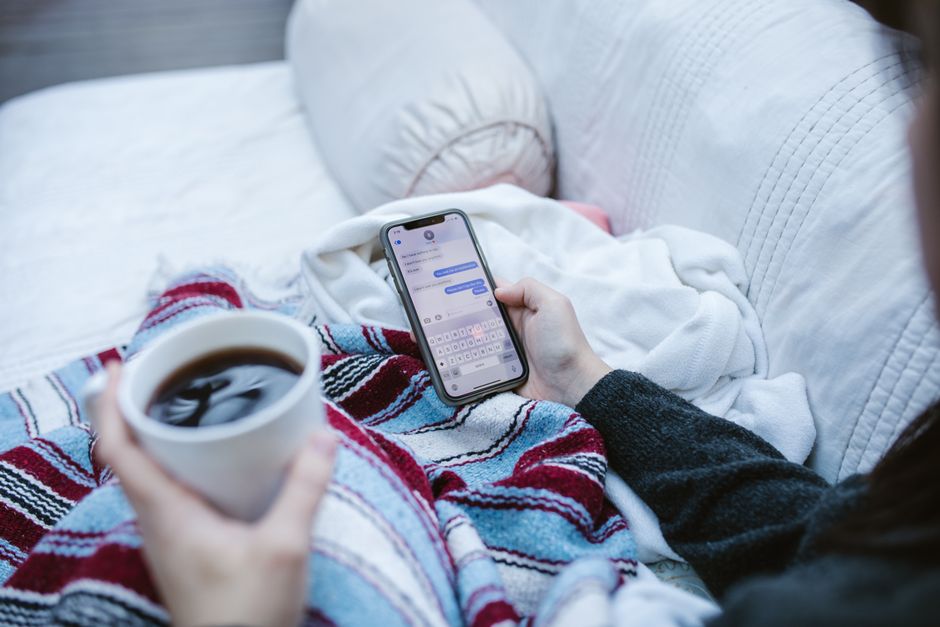
The best messages aren't rushed — they're chosen. Photo by RDNE Stock project via Pexels.
How does asynchronous design make us more thoughtful, not less?
One of the underrated gifts of digital communication is time.
A live conversation rewards speed — the quick reply, the reflexive answer. Asynchronous communication, the kind you compose and send on your own clock, rewards something better. Because there's no pressure to respond in the moment, people tend to slow down, add context, and think before they commit, producing higher-quality, more considered communication rather than fast, impulsive reactions (as widely documented in research on asynchronous communication). The gap between impulse and send is where care lives.
Well-designed personalization tools lean into that gap on purpose. A flexible design space — where you can shape the words, the layout, and the visual mood rather than dropping text into a fixed slot — turns "sending a card" into a small, deliberate act of composition. That friction is a feature. It's the room in which you notice you want to say something truer than your first draft.
There's a beautiful and slightly humbling body of research here. In studies published in Psychological Science, Amit Kumar and Nicholas Epley found that people who wrote letters of gratitude consistently underestimated how good those letters would make recipients feel, and overestimated how awkward the whole thing would be (Kumar & Epley, Psychological Science). We talk ourselves out of reaching out because we misjudge the math — we assume it'll land smaller and clumsier than it does. Tools that make heartfelt expression low-friction and low-stakes are, in a real sense, correcting for that bias. They make it easier to do the thing we already underrate.
Nugget: You almost certainly underestimate how much your message will mean to the person who gets it. The research is unusually clear on this.
Can technology actually strengthen relationships, or just distract us?
Both are true — which is exactly why design matters so much.
The distraction side is real and worth naming. The U.S. Surgeon General's 2023 advisory described loneliness and isolation as a public-health crisis, noting that the mortality risk of social disconnection is comparable to smoking up to 15 cigarettes a day, and that heavier social-media use is associated with greater feelings of isolation (U.S. Surgeon General, Our Epidemic of Loneliness and Isolation). Passive, endless, comparison-driven screen time genuinely corrodes connection.
But that's not the whole story of the screen. The same devices, used with intention, keep people close across distance. Pew Research Center found that among adults in serious relationships, a meaningful share of younger couples said online or text-message conversations had made them feel closer to their partner (Pew Research Center, Couples, the Internet, and Social Media). The technology is not the variable. How it's designed and used is the variable. Infinite-scroll feeds optimize for your attention. Well-built personalization tools optimize for your intention — a single, specific act of reaching toward one particular person. Those are opposite goals wearing the same hardware.
| Optimized for attention | Optimized for intention | |
|---|---|---|
| Core question | "How do we keep you here?" | "How do we help you reach one person?" |
| Default output | Endless, generic, for everyone | Singular, specific, for someone |
| Emotional effect | Comparison, passivity, drift | Being seen, being remembered |
| What it leaves behind | A blur | A moment they keep |
What does human-centered personalization technology look like in practice?
Strip away the jargon and it comes down to a few design commitments — the kind worth looking for in any tool that promises to help you connect:
- It starts from feeling, not format. The first question the tool asks (implicitly, through how it's organized) should be what do you want to express? — not what's the occasion?
- It offers real range, then gets out of the way. A curated library of genuine artistry — human-made illustration, photography, animation — gives you something worth sending; flexible design controls let you make it unmistakably yours without demanding you be a designer.
- It rewards care instead of speed. The experience should invite a pause, not punish one. Thoughtfulness is the whole point.
- It keeps you as the author. The person, not the algorithm, decides what's said. The technology is the ally, not the ghostwriter.
That last one is the quiet philosophy behind TheBlueBrook's approach to digital allyship: the platform's role is to widen what you can say and lower the effort of saying it well — never to say it for you. The artistry and the architecture are there so that your specific, human intention arrives intact.
Used with intention, the same screen that isolates can also close the distance. Photo by RDNE Stock project via Pexels.
How can you use this the next time you reach out?
You don't need new technology to apply the principle. You need a slightly different instinct:
- Begin with the feeling. Before you think about the occasion or the words, name what you want them to feel. Choose from there.
- Let yourself take the time. Use the gap that asynchronous messaging gives you. Your second thought is usually truer than your first.
- Trust that it'll land bigger than you expect. The gratitude research is on your side: send it anyway.
- Choose tools that serve your intention, not their metrics. Ask whether a platform is trying to keep you scrolling or help you reach one person well.
- Stay the author. Use technology to expand your expression, never to outsource your meaning.

Good design gives you range without demanding expertise. Photo by Ivan S via Pexels.
Frequently asked questions
Does personalization technology make messages feel less authentic? It depends entirely on what the technology is designed to do. Tools built to generate messages for you can flatten authenticity; tools built to help you express your own specific intention — by offering range and lowering friction — tend to increase it. Authenticity lives in the human choice, and good design protects that choice.
Isn't a handwritten card always more meaningful than a digital one? Not necessarily. What makes any message meaningful is evidence of attention — that it was chosen for this person. A digital message assembled with genuine care can carry that evidence as clearly as ink can, and it can reach someone across the world in the moment it matters.
Why start from emotion instead of the occasion? Because the occasion is rarely the real reason you're reaching out — the relationship is. Organizing by feeling rather than by holiday points you at what you actually want to say, which is why platforms like TheBlueBrook index their artwork by mood and emotional association rather than by prescriptive categories.
Can sending a thoughtful digital message really affect someone's wellbeing? Yes. Feeling understood activates the brain's reward and connection circuitry (Morelli et al.), and expressions of appreciation reliably mean more to recipients than senders expect (Kumar & Epley). A small, specific message is a real act of care.
The last word
The anxiety that technology is making us colder gets the diagnosis half right. Some technology is — the kind engineered to hold your attention rather than help your intention. But that's a design choice, not destiny. Built the other way, around emotion and artistry and the simple goal of helping one person reach another, technology becomes what it should have been all along: an ally in the very human work of making someone feel known.
The tool was never the problem. The question is only ever what we build it to help us say — and, in a world quietly starved for connection, whether we choose to say it at all.
Sources
- Morelli, S. et al. — The neural bases of feeling understood and not understood, Social Cognitive and Affective Neuroscience. Link
- Kumar, A. & Epley, N. — Undervaluing Gratitude: Expressers Misunderstand the Consequences of Showing Appreciation, Psychological Science. Link
- U.S. Surgeon General — Our Epidemic of Loneliness and Isolation (2023). Link
- Pew Research Center — Couples, the Internet, and Social Media (2014). Link
- Coursera — What Is Asynchronous Communication (And Why It's Essential)? Link