Why an Old Photo Hits Harder Than a New Notification
We're more digitally "connected" than any generation before us — and more likely to feel alone. Here's what psychology says about why nostalgia, personalization, and a handful of well-chosen words can do what a hundred notifications can't.
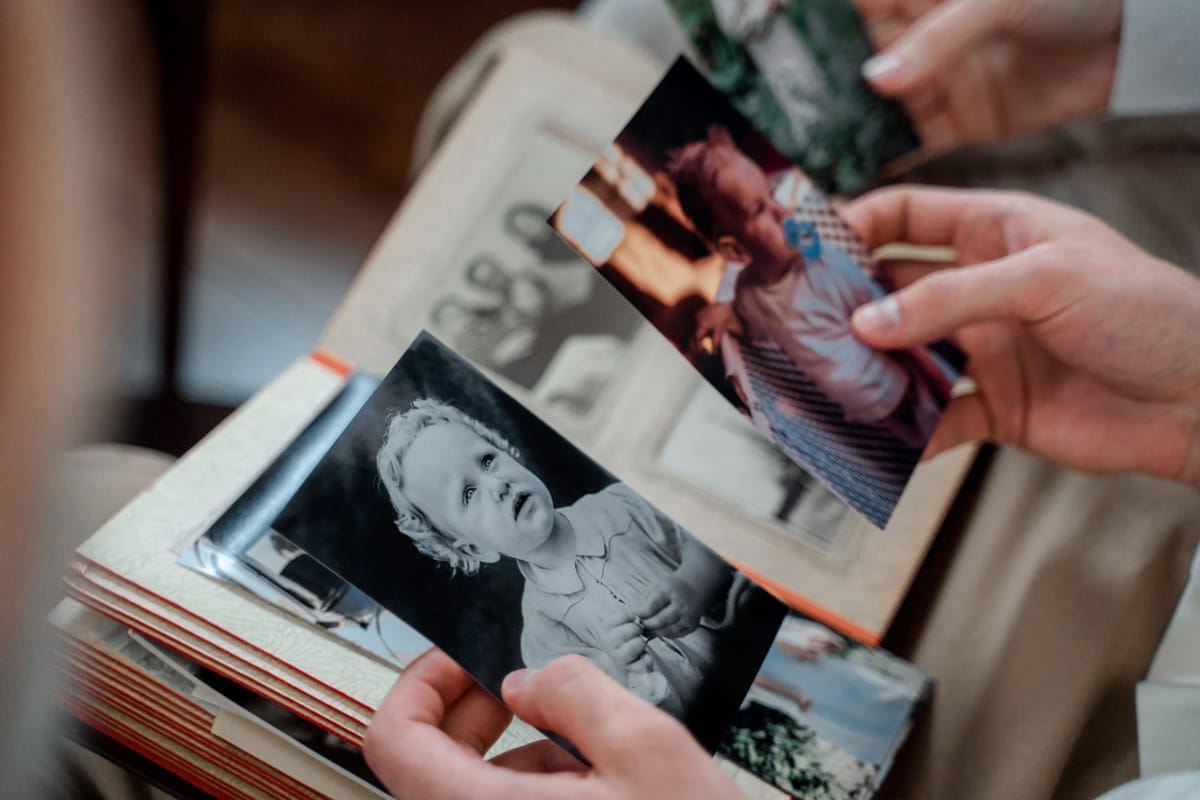
Somewhere between the 47th notification of the day and the last group chat you scrolled past without reading, a single old photograph shows up in your camera roll — you and a friend, a decade younger, laughing at something you can no longer remember. And it stops you. Not because it's new information. Because it isn't.
That small jolt is worth paying attention to. We live inside more communication channels than any humans in history have ever had access to, and yet public health bodies are treating disconnection as a genuine crisis. The World Health Organization's Commission on Social Connection has linked chronic loneliness to roughly 871,000 deaths a year worldwide, and the U.S. Surgeon General's 2023 advisory found that lacking social connection carries a mortality risk comparable to smoking up to 15 cigarettes a day.
So here's the real question this article is trying to answer: if we're more "in touch" than ever, why does so much of that contact feel weightless — and what actually makes a message, a card, or a small gesture land?

Why Does an Old Photo Hit Harder Than a New Notification?
The short answer is nostalgia — and it's doing more psychological work than most people realize.
Researchers have spent nearly two decades studying this specific emotion, and the findings are remarkably consistent. Nostalgic reflection reliably increases people's sense of social connectedness, and this effect has been replicated across North America, Europe, and Asia, in both younger and older adults. It isn't a passive, sentimental side-effect either — nostalgia measurably improves mood and self-esteem, and people who are prompted to feel nostalgic show a greater desire to help and connect with others afterward.
There's a reason it works this way. Nostalgia tends to surface in moments of loneliness or difficulty, almost like an internal repair mechanism — a way of reminding you that you have been cared for before, and can be again. One synthesis of this research describes nostalgia as fundamentally social in content: when people recall nostalgic memories, other people are almost always in the frame.
A quiet nugget to sit with: the people you're most nostalgic about are very often the people you've gone the longest without properly reaching out to. That's not a coincidence — it's a signal.
What Does the Research Actually Say?
Here's a quick summary of what the evidence shows, pulled together for anyone who wants the receipts rather than the vibes:
| Finding | Source |
|---|---|
| Nostalgic reflection increases social connectedness; effect replicated 12+ times across cultures | Wildschut et al., Journal of Personality and Social Psychology (via ScienceDirect synthesis) |
| Nostalgia improves mood and self-esteem, especially following loneliness or negative events | Wildschut et al., 2006 |
| Nostalgia increases people's felt capacity to support others emotionally | Wildschut et al., Journal of Personality and Social Psychology, 2010 |
| Nostalgia is future-oriented as much as past-oriented — it motivates present-day connection | Frontiers/PMC neuroscience review |
| Nostalgia fosters gratitude via social connectedness as the underlying mechanism | Green, Wildschut & Sedikides, ScienceDirect, 2025 |
The throughline across all of it: nostalgia isn't backward-looking sentimentality. It's a psychological bridge — pulling something meaningful from the past forward into a present-day action, like reaching out to someone.
Why Do Personalized Gestures Land Differently Than Generic Ones?
This is where personalization enters the picture, and the research here is just as compelling.
A 2024 study out of the University of Bath — published in Psychology & Marketing and involving researchers across the UK, France, and Switzerland — identified something they termed "vicarious pride": when someone receives a gift or gesture that was clearly personalized for them specifically, the recipient experiences a version of the pride the giver felt while creating it. It's a strange, generous kind of emotional transfer. The researchers also found that small "made by" signals — a name, a short note about the thought behind it, a visual mark of customization — measurably deepen that emotional connection between giver and recipient.
Put simply: personalization isn't a nice-to-have aesthetic layer. It's the mechanism that converts a generic gesture into an emotionally resonant one. A card that says "Happy Birthday" in a template font is information. A card where someone chose the imagery, wrote in their own words, and shaped the message around a specific memory is recognition — and recognition is what the psychology keeps pointing back to.
Nugget: the goal was never to send a card. It was always to send this card — the one that could only have been made with this person in mind.
Are We More Connected, or Just More Available?
This is the tension sitting underneath the whole conversation about modern communication, and it's worth being honest about it.
Longitudinal research out of Baylor University, tracking social media use over nine years, found that both passive scrolling and active posting were associated with rising loneliness over time — suggesting the quality of digital interaction, not just the quantity, is the issue. A separate Oregon State University study of over 1,500 U.S. adults aged 30–70 found that the most frequent, high-volume social media users were more than twice as likely to report loneliness as lighter users, a pattern that held even after adjusting for age, employment, and relationship status.
None of this means digital tools are the villain. It means generic digital contact — the reflexive like, the mass-forwarded meme, the templated notification — doesn't do the same psychological job as a considered, personal one. There's an emerging cultural response to this too: commentators have started describing a shift toward what's been called "friction-maxxing" — a deliberate preference for interactions that take more effort, because effort is precisely what signals care.
This is the emotional logic that a thoughtfully designed, deeply personal digital gesture can tap into — not by trying to replace real connection, but by actually carrying it.
What Does "Meaningful" Even Mean in a Fragmented World?
If you strip away the marketing language most communication tools use, "meaningful" tends to come down to three things, all of which show up directly in the research above:
- Specificity — it could only have been made for this one person.
- Effort made visible — the recipient can tell something was chosen, not just clicked.
- An invitation to remember — it draws on shared history rather than generic sentiment.
Most mainstream greeting and messaging tools are built around the opposite of all three: categories, templates, and surface-level occasions (birthday, congratulations, thinking of you) that make sending fast but rarely make it specific. There's a quiet irony in an industry built to help people express emotion, defaulting to the most generic version of it available.
The alternative isn't more effort for effort's sake — it's designing communication tools around emotional and psychological association rather than occasion. A message organized around a feeling, a memory, or a shared image rather than a calendar category leaves more room for the sender to actually mean something specific, and for the recipient to feel it.
How Do You Actually Bring More of This Into Daily Life?
A few concrete, research-backed starting points:
- Send the nostalgic thing before you overthink it. The instinct to reach out after remembering someone is exactly the moment the research says to act on — it's when connection actually gets rebuilt, not just recalled.
- Choose imagery and words with someone specific in mind, not a category. A landscape that reminds you of a trip together will always outperform a generic "miss you" template.
- Make the effort visible. A short, specific line ("this reminded me of the summer we...") does more psychological work than a longer, generic one.
- Treat digital tools as a bridge, not a replacement. The research is consistent: the goal of any message is to prompt real connection, not substitute for it.
- Don't wait for an occasion. Some of the most powerful nostalgic and personal gestures happen with no calendar reason at all — which is often what makes them feel more genuine.
Nugget: the best time to send something meaningful is rarely a holiday. It's usually a Tuesday, for no reason at all, which is exactly why it works.
Frequently Asked Questions
Does nostalgia actually improve relationships, or does it just feel nice? Both — feeling nostalgic reliably improves mood and self-esteem, but its most consistent effect across studies is increasing people's sense of social connectedness and their motivation to reach out to others.
Is social media making people lonelier? Research suggests it depends more on how platforms are used than whether they're used — both passive scrolling and high-frequency active use have been linked to increased loneliness over time, while genuine, personal digital contact functions differently.
Why do personalized messages feel more meaningful than generic ones? Studies on personalization show recipients experience something researchers call "vicarious pride" — a sense of the giver's effort and thought transferring emotionally to the recipient, which generic, templated messages can't replicate.
Does a digital card or message really count as "meaningful" communication? The format matters far less than the specificity and effort behind it. A personal, image- and memory-driven message can carry real emotional weight; a templated, occasion-based one typically carries less, regardless of medium.
Closing Thought
None of this is really about greeting cards, or notifications, or apps. It's about the fact that human beings are still wired to notice the difference between something made for them and something sent at them — and that difference is measurable, replicable, and worth designing for.
That's the quiet idea behind The Story of Sending Something Lovely: that in a world full of fast, generic ways to stay "in touch," the ones that actually matter are still the ones built around a specific person, a specific memory, and a little bit of deliberate effort. The Art of Sending Something Lovely was never about the sending. It was always about the meaning underneath it.