The Case Against Sameness: Why Curated Art Still Beats the Algorithm
Generative tools can produce an image in seconds — so why do people still reach for the human-made version? A look at the psychology of authenticity, effort, and sameness, and why curation is becoming the harder job to automate.

The Case Against Sameness: Why Curated Art Still Beats the Algorithm
Ask a generative model for "a warm, emotional illustration of two people reunited" and you'll have one in under ten seconds. Ask for a hundred more and you'll have a hundred more, each competent, each on-brief, each — if you look at them side by side — strangely interchangeable. That speed is real and the technology behind it is genuinely impressive. What's less discussed is what happens on the other end of that speed: the growing, measurable gap between content that was produced and content that was chosen.
That gap is where curation lives, and research from the last two years suggests it's becoming more valuable, not less, exactly as generation gets cheaper.
Why do people still prefer human-made art, even when they can't tell the difference?
Across a field study and three lab experiments, researchers found that people consistently prefer artwork they believe was human-made over artwork they're told is AI-generated — and rate the AI version as less creative — even when the two are visually comparable (Feng, Journal of Consumer Behaviour, 2026). The effect isn't really about the pixels. It's about identification: viewers empathize with a human creator in a way they simply can't with a model, and that empathy is what converts a picture into something felt rather than just seen. A separate cross-cultural study of Chinese and U.S. viewers found the same pattern held in both groups — willingness to engage went up the moment people believed a human made the piece, regardless of cultural background (Digital Society, 2026).
That's a meaningful finding for anything meant to carry an emotion between two specific people. A greeting, a card, a message meant to say I see you only works if the recipient can, in some sense, feel a person on the other end of it. Authenticity isn't a nice-to-have layered on top of the image. It's the mechanism the whole thing runs on.
Nugget: People don't just prefer human-made art because it looks different — they prefer it because they can imagine a person behind it. That imagined person is doing real emotional work.
Does knowing something took real effort change how much it's worth to us?
Yes, and this one predates AI by two decades. The "effort heuristic," first demonstrated by Kruger, Wirtz, Van Boven, and Altermatt in 2004, found that people judge an object as higher quality and higher value simply because they believe more effort went into making it — the same poem, framed as having taken longer to write, gets rated better (Kruger et al., Effort heuristic). A related line of research, the "labor illusion," found that people prefer outcomes from processes that visibly show their work — a search that visibly "thinks" for a few seconds is trusted more than an instant one, even when the results are identical (Buell & Norton, Management Science, 2011).
There's an important nuance buried in that research, though: the effort heuristic weakens when people believe the outcome depends on raw talent rather than labor — if you think great art can't be taught, effort stops mattering as much as skill does. Which points to what actually survives as valuable in a world of instant generation. It isn't effort alone, and it isn't talent alone. It's curation — the visible, skilled act of selecting the one image, out of everything possible, that's right for this person and this moment. That's a compound signal: it says someone with taste looked, and chose, on your behalf.
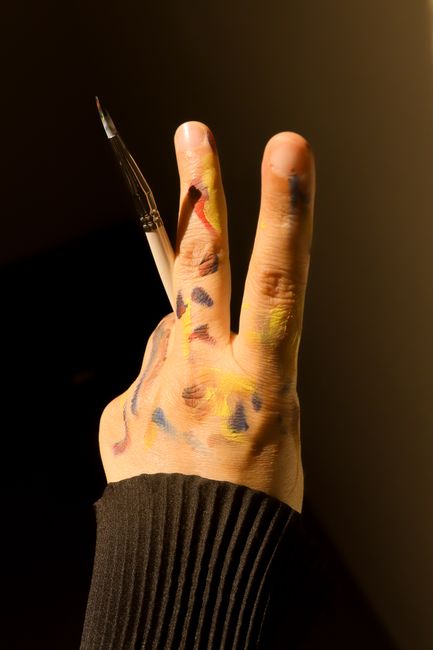
Effort doesn't have to mean labor over a canvas — it can mean the visible care of a good selection. Photo by Mysara Hassan via Pexels.
What happens when every platform reaches for the same generative engine?
Here the research gets more structural, and more useful for understanding why "sameness" isn't just a vibe people complain about — it's a measurable property of how these systems behave. A landmark 2024 study published in Nature trained AI models recursively on their own generated output across generations, and found a consistent pattern: each generation's outputs narrowed, losing the rare, unusual, tail-end variety present in the original human-made training data, and drifting toward a flattened, average version of the middle (Shumailov et al., Nature, 2024). Researchers now call this model collapse, and its logic scales beyond training data: when a huge share of a category's content is generated by a small number of shared underlying models, the category itself starts to regress toward a statistical average, whether or not any single output looks bad.
That's the mechanism behind what's increasingly being called "AI slop" — content that's individually competent but collectively indistinguishable, because it was all pulled from the same narrowing distribution rather than a wide range of distinct human perspectives (Forbes Business Council, 2026). A library built from many individual working artists — each with their own eye, references, and technique — doesn't have that convergence problem, because there's no shared statistical center for it to collapse toward. Diversity of authorship isn't just a values statement in that context. It's a structural defense against sameness.
| Curated human library | Shared generative engine | |
|---|---|---|
| Source of variety | Many individual artists, each with a distinct eye | One or few underlying models |
| Trend over time | Stays as varied as the artists contributing to it | Tends to narrow toward an average output |
| What a viewer identifies with | A specific person's perspective | An unowned, generated output |
| Effort signal | Visible skilled selection or making | Ambiguous or absent |
So is there no room at all for AI in something built to feel personal?
Not quite — the honest answer is more specific than "AI bad, human good." These findings aren't an argument against the technology broadly; they're an argument about where in the process authenticity has to live. Generative tools can be genuinely useful for logistics — drafting a first pass of wording, suggesting layout options, handling delivery mechanics — the parts of sending something that were never where the emotional weight sat in the first place. What the research says shouldn't be automated away is the moment of selection: the actual image, the actual piece that gets attached to a message meant for one specific person.
That's the distinction a curated artist library is built to protect. When a platform organizes illustration, photography, animation, and concept art by mood and emotional association — rather than generating something new and average for every request — the thing a sender ultimately picks still traces back to a working artist's actual eye and hand, not a blended statistical middle. It's a different bet than generation-at-scale: fewer total possible outputs, but every one of them still identifiably made by someone, which the research above suggests is exactly the property that makes people feel something when they open it.
Nugget: The most personal thing about a message often isn't the words. It's that someone with real taste chose this specific image, for this specific person, out of everything they could have chosen instead.
What this means if you're choosing something to send
- Notice what you're actually drawn to. If an image feels distinct rather than merely competent, that's often the authenticity research talking — you're responding to a legible point of view, not just correct composition.
- Effort still counts, but curation counts more. You don't need to make something by hand for it to carry a real effort signal — choosing carefully, from a genuinely wide and varied set of options, reads the same way.
- Be wary of anything that feels instantly, universally applicable. If an image or message could have been sent to anyone, for any reason, that's usually a sign it was pulled from the flattened middle rather than selected with someone specific in mind.
- Favor platforms that keep authorship visible. A credited artist behind an image isn't a footnote — per the research on authenticity and identification, it's part of what makes the image land.
FAQ
Isn't AI-generated art getting good enough that people won't be able to tell the difference? Visual quality and perceived authenticity are turning out to be separate variables. Even in studies where viewers couldn't reliably tell which image was AI-generated, simply believing a piece was human-made increased preference and perceived creativity — the effect runs on belief and identification, not just detectable quality.
Does this mean generative AI has no place in the greeting card or digital messaging industry? No — it's well suited to logistics: draft copy, layout suggestions, workflow automation. The research specifically concerns the emotional core of a message: the image or artwork that's meant to carry feeling. That's the part where human authorship and curated selection still measurably outperform generation.
What's "model collapse," in plain terms? It's what happens when AI models are trained repeatedly on their own (or each other's) output rather than fresh human-made material — each generation loses some of the rare, unusual variety of the original data, and the outputs drift toward a narrower, more average version of themselves.
Why does curation resist this "sameness" problem when generation doesn't? Because curation's variety comes from many individual human perspectives contributing to the pool, rather than from one shared underlying model generating on demand. There's no common statistical center for a library of distinct artists to converge toward.
The last word
None of this is an argument that machines can't produce something beautiful — they routinely do. It's an argument about what a viewer is actually responding to when something moves them: not just competent output, but the sense of a specific person behind it, who made a specific choice, for a specific reason. That sense is exactly what gets lost first when content is generated at scale from a shared engine, and exactly what a library built from many individual artists is structurally positioned to keep. As generation gets faster and cheaper for everyone, the harder, more valuable job turns out to be the oldest one: looking carefully, and choosing well.