
Why Images Move Us: The Psychology of Visual Emotion (and How to Say What Words Can't)
Long before we find the right words, an image can say exactly what we feel. Here's the psychology behind why pictures move us — and how to use it to make people you love feel truly seen.


Why Images Move Us: The Psychology of Visual Emotion (and How to Say What Words Can't)
You have felt it, even if you have never named it. A friend sends a photo of a rain-soaked window and, somehow, it lands more truly than the paragraph they could have typed. You scroll past a painting of a small boat on a wide sea and feel a tug you can't fully explain. Before language arrives, the image is already working on you.
This isn't sentimentality. It's neuroscience. The way a picture reaches into us — quickly, bodily, sometimes before we're ready — is one of the most reliable findings in the psychology of emotion. And in an era where so many of our relationships live on screens, understanding it is quietly practical. It changes how we reach for one another.
Nugget: Words describe a feeling. An image transmits one. That difference is why the right picture can say "I'm thinking of you" better than the sentence ever could.
Why do images evoke emotion faster than words?
Because they take a shorter path to the parts of the brain that feel.
Reviewing decades of research on mental imagery, psychologists Emily Holmes and Andrew Mathews found that imagery produces stronger emotional responses than the same content in words, and they proposed why: images make more direct contact with the brain's emotional systems, they overlap heavily with the machinery of actual perception (so we respond "as if" the scene were real), and they hook efficiently into our autobiographical memories (Holmes & Mathews, Clinical Psychology Review). A word has to be decoded into meaning before it can move you. A picture is already halfway to the feeling.
Brain-imaging work supports the same idea. When people process pictures rather than words, a far wider network lights up — visual, parietal, temporal, frontal, and deeper subcortical regions — while single words tend to activate a much narrower slice of cortex (Psychology Today). More of the brain is recruited, so more of you responds.
| How we take it in | What the brain does | What it feels like |
|---|---|---|
| A written sentence | Decode symbols → construct meaning → then feel | Considered, deliberate, "I understand" |
| A photograph or artwork | Perceive → emotional systems engage almost at once | Immediate, embodied, "I feel that" |
| A remembered image | Reactivates the original emotional episode | Vivid, personal, "I'm back there" |
This is why choosing an image is never a small decision. You are not decorating a message. You are choosing which door into someone's feelings you want to walk through.
How do emotions actually pass from one person to another?
Through a phenomenon researchers call emotional contagion — the largely automatic, often unconscious way we catch the feelings of the people around us.
We tend to assume this requires presence: a face, a voice, a room. It doesn't. In a now-famous study of nearly 690,000 people, researchers showed that emotional states spread through a network even when the usual nonverbal cues were stripped away entirely — the emotional tone of what people encountered shifted the emotional tone of what they later expressed (Kramer, Guillory & Hancock, PNAS). Feeling travels through content, not just through bodies.
That finding cuts both ways, and it's worth being honest about it. The same channels that carry warmth carry anxiety and outrage just as efficiently — often more so. Which means the emotional texture of what we send is not neutral. When you deliberately send someone tenderness, calm, or delight, you are not just brightening their afternoon. You are placing a small, specific feeling into a current that will keep moving.
Nugget: Every image you send is a little act of emotional contagion. The only question is which emotion you're choosing to pass along.
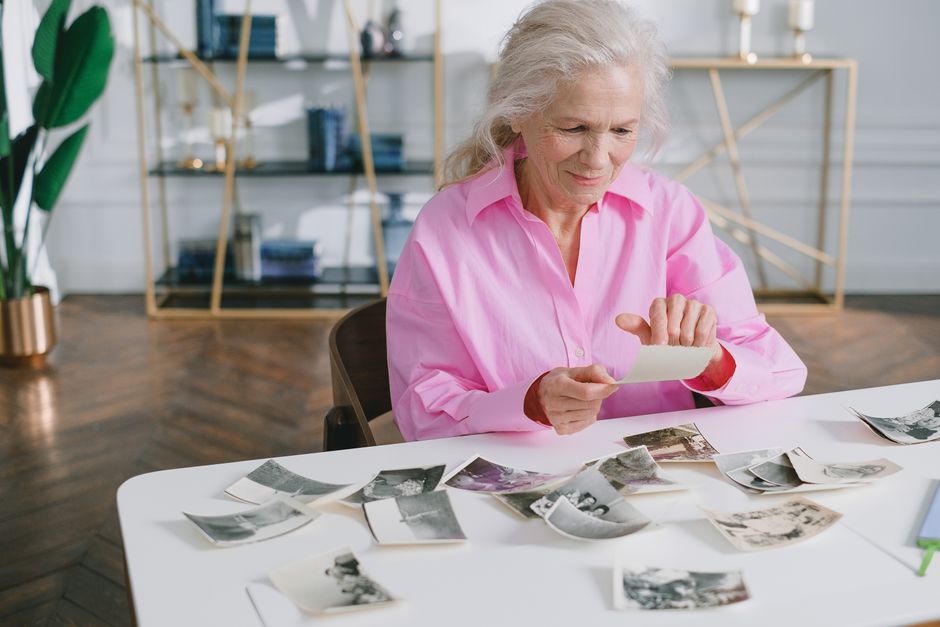
Images don't just show the past — they reopen the feeling of it. Photo by SHVETS production via Pexels.
Why does the "right" image make someone feel truly seen?
Because being understood is one of the deepest human rewards we have — and imagery is a shortcut to it.
Feeling understood isn't a soft nicety; it registers in the brain's reward circuitry. Neuroscience research found that the experience of feeling understood activates regions tied to reward and social connection (the ventral striatum and middle insula), while feeling misunderstood lights up areas associated with negative emotion (Social Cognitive and Affective Neuroscience). We are, quite literally, wired to find relief and joy in being gotten.
And the effect accumulates in ordinary life. In a two-week diary study, people reported greater life satisfaction and even fewer physical symptoms on the days they felt more understood by others (Oishi et al., Personality and Social Psychology Bulletin). Being seen isn't just pleasant. It's good for you.
Here's where imagery earns its keep. A generic card says I did the socially expected thing. An image chosen because it captures this person — their particular melancholy, their specific joy, the inside color of a shared memory — says I know you. It's the difference between a message addressed to a category and a message addressed to a soul. The picture does what a paragraph strains to do: it proves attention.
Does this matter more now than it used to?
It does — and the data isn't subtle.
The U.S. Surgeon General's 2023 advisory described loneliness and isolation as a genuine public-health crisis. The mortality risk of being socially disconnected, the report noted, is comparable to smoking up to 15 cigarettes a day, and Americans have been spending steadily more time alone and less time with friends in person for two decades (U.S. Surgeon General, Our Epidemic of Loneliness and Isolation). The same advisory flagged that heavier social-media use is associated with greater feelings of isolation — a painful irony for tools built to connect us.
The lesson isn't to log off. It's to use our screens with more intention. If disconnection is the disease, then small, sincere, emotionally-specific acts of reaching out are part of the medicine. A thoughtless like does little. A message built around an image that says this reminded me of you does something the research would predict: it makes the other person feel understood, and it passes along a warmer emotion than the feed is likely to.

Connection is a practice, not an accident. Photo by Nano Erdozain via Pexels.
How can you use the psychology of visual emotion in everyday life?
You don't need to be an artist. You need to be attentive. A few small, evidence-aligned habits:
- Lead with the image, not the occasion. Instead of asking "what's the event?", ask "what do I want them to feel?" Choose the picture that carries that feeling first, then let the words follow.
- Choose specificity over polish. A slightly imperfect image that is unmistakably theirs beats a flawless generic one. Specificity is the proof of attention that makes people feel seen.
- Match the emotion to the person, not the calendar. The most moving messages often arrive on no special day at all. An ordinary Tuesday is when being remembered means the most.
- Mind the current you're adding to. Because emotion is contagious, treat "what am I passing along?" as a real question. Aim for warmth, calm, delight, or steadiness.
- Let the picture do the heavy lifting. You don't have to explain the feeling in words. Often the strongest message is a resonant image and one honest line beneath it.
This is the quiet philosophy behind TheBlueBrook. Rather than sorting cards by holiday, its artist library is organized the way feelings actually work — by mood and emotional association, by the imagery of landscapes, space, animals, and love — so you can start from the emotion you want to send and find the picture that already holds it. It's a small design choice with a psychological point: when the image comes first, the message comes from a truer place.
Nugget: You don't have to find the perfect words. You have to find the picture that already knows what you mean.
Frequently asked questions
Why do images stay in memory longer than text? Images engage a broader network of brain regions and tie more readily into existing memories and emotions, which makes them both easier to process and more likely to stick (Holmes & Mathews). A feeling attached to a picture has more hooks to hang on.
Can a digital image really create genuine emotional connection? Yes. Research on emotional contagion shows feelings can transfer between people even without in-person cues (PNAS), and feeling understood — which a well-chosen image can create — activates the brain's reward and connection circuitry (SCAN). The screen is a medium, not a barrier.
Isn't sending a picture lazier than writing a heartfelt note? Not when it's chosen with care. The effort that matters is attention, not word count. An image selected because it genuinely captures the other person is a form of being seen — and that's precisely what the research links to wellbeing (Oishi et al.).
What kind of image works best for emotional messages? One that is specific to the person and matches the feeling you want to pass along. Resonance beats production value. The goal isn't a beautiful picture — it's the right one.
The last word
We spend a lot of energy searching for the words. But the older, faster language of feeling was never verbal. It's the boat on the wide sea, the rain on the window, the color that means something only the two of you would understand. When you learn to reach for the right image, you're not skipping the effort of connection — you're speaking connection in its first language.
In a world that keeps pulling us apart, that's not a small thing to know. It might be one of the loveliest.
Sources
- Holmes, E. A. & Mathews, A. — Mental imagery in emotion and emotional disorders, Clinical Psychology Review. Link
- Kramer, A., Guillory, J. & Hancock, J. — Experimental evidence of massive-scale emotional contagion through social networks, PNAS. Link
- Morelli, S. et al. — The neural bases of feeling understood and not understood, Social Cognitive and Affective Neuroscience. Link
- Oishi, S. et al. — On Feeling Understood and Feeling Well: The Role of Interdependence, Personality and Social Psychology Bulletin. Link
- U.S. Surgeon General — Our Epidemic of Loneliness and Isolation (2023). Link
- Psychology Today — Seeing the Light: How Visual Mental Imagery Can Evoke Emotion. Link