
Why the First Three Seconds of a Video Greeting Card Decide Everything
A hosted MP4 and an adaptive stream can carry the exact same video — but only one of them survives the first three seconds of a shaky connection. Here's the technical difference, and why it matters more for an emotional message than almost any other kind of video.

Why the First Three Seconds of a Video Greeting Card Decide Everything
There's a specific kind of disappointment reserved for technology getting in the way of feeling. Someone sends a video message — a birthday greeting, a "thinking of you," a proposal, an apology — and the recipient taps play, and then: a spinner. A gray box. Three seconds. Five. By the time the video actually resolves, the moment it was built to deliver has already leaked out through the wait.
This isn't a minor annoyance. It's a structural mismatch between how emotional moments are supposed to unfold and how a lot of video content is technically served. And the fix isn't a better video — it's a different delivery format.
What's the actual difference between a hosted MP4 and adaptive streaming?
A hosted MP4 is a single video file sent as a progressive download: one resolution, one bitrate, delivered as one continuous file regardless of the viewer's connection. If the recipient's network can't keep up, the file doesn't adjust — it just stalls while more of it downloads.
Adaptive streaming (the category HLS — HTTP Live Streaming — belongs to) works differently. The same video is encoded at multiple quality levels and cut into short segments. The player continuously measures the viewer's real-time bandwidth and requests whichever segment quality that connection can actually sustain, upgrading or downgrading every few seconds as conditions change. Two people watching the same video card — one on strong home Wi-Fi, one on spotty cellular at a train platform — each get a version tuned to what their connection can carry, without either of them seeing a stalled progress bar.
| Hosted MP4 (progressive download) | Adaptive streaming (HLS) | |
|---|---|---|
| Startup behavior | Waits for enough of the fixed file to buffer | Starts at a low-risk quality, adjusts immediately |
| Weak or variable connection | Stalls; playback pauses until more downloads | Drops resolution automatically, keeps playing |
| Mobile network switching (Wi-Fi → cellular) | No adjustment mid-playback | Re-evaluates bandwidth continuously |
| What the viewer notices | A frozen frame, a spinner | Nothing — a slightly softer picture for a moment |
The technical explanation is straightforward enough that it undersells the stakes. What's actually at risk isn't video quality — it's whether the emotional moment survives contact with an unpredictable network.
Why does a few seconds of buffering wreck something that should feel personal?
Video research backs this up with numbers that are more dramatic than most people expect. Streaming infrastructure company Mux has found that a single buffering event reduces the amount of a video someone watches by roughly 40% — one interruption is enough to cut a viewing session nearly in half. A widely cited academic study of internet video behavior, published in IEEE/ACM Transactions on Networking and known as "YouSlow," found that viewers begin abandoning video that takes more than about two seconds to start, with each additional second of delay increasing abandonment by roughly 6% — and that by the ten-second mark, more than half the original audience is already gone.
Those numbers were measured on ordinary streaming video — news clips, tutorials, entertainment. A video greeting card is a different kind of content entirely, and arguably far less tolerant of the same delay.
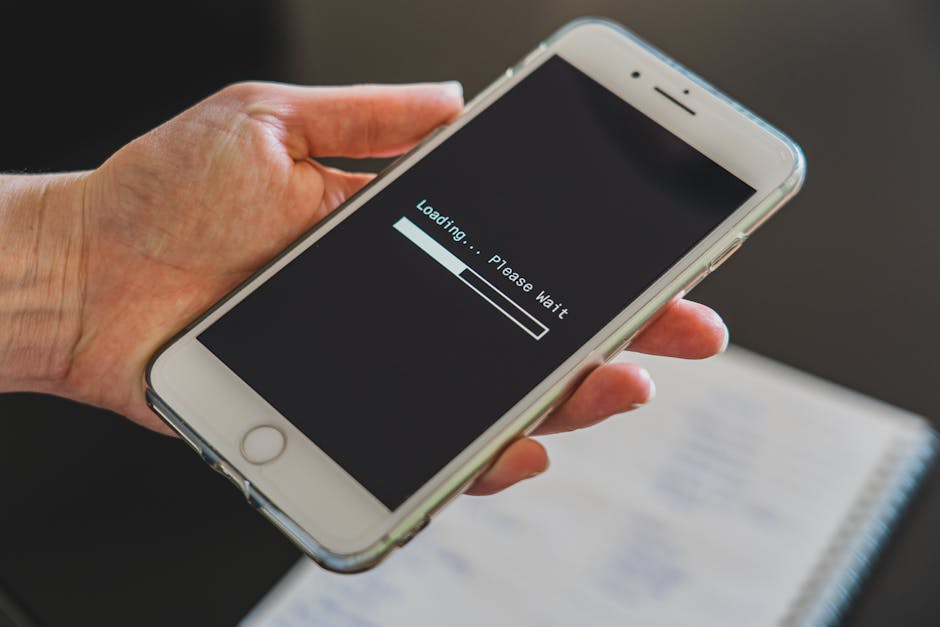
The exact screen a video greeting card is engineered never to show. Photo by Castorly Stock via Pexels.
Nugget: A tutorial video that buffers is annoying. A video message from someone you love that buffers is disappointing — because the wait doesn't just cost attention, it costs the split-second the moment was supposed to land in.
That split-second matters because of how first impressions get encoded in memory. Psychology's well-documented primacy effect describes how information — and the emotional tone — encountered first gets disproportionate weight in what's ultimately remembered, in part because attention and emotional processing are both at their sharpest in that opening window. A video card's entire design is built around delivering its emotional payload inside that same window: a face lighting up, a voice cracking, a "surprise" reveal. If a stalled buffer eats into the first two or three seconds, it isn't just delaying the content — it's dulling the exact moment the content was engineered to hit hardest. This is consistent with broader research on imagery and emotion, which has found that visual and moving content reaches the brain's emotional systems more directly and quickly than text does — which is precisely why a video card is worth sending in the first place, and precisely why protecting its opening seconds is worth engineering for.

The reaction the whole delivery chain exists to protect. Photo by Tima Miroshnichenko via Pexels.
What does the delivery infrastructure actually have to get right?
Getting adaptive streaming right isn't just about the encoding format — it also depends on how close the video actually is to the viewer when they hit play. This is the role of a content delivery network (CDN): rather than every viewer's device requesting video from one distant origin server, a CDN caches copies of that content on edge servers physically closer to where the request is coming from, cutting the physical distance data has to travel and, with it, the latency before playback can begin.
Put an adaptive stream on a CDN with good edge coverage, and the two effects compound: the player is already requesting a network-appropriate quality level, and that request is answered from nearby infrastructure instead of across a continent. The result, done well, is close to invisible — which is exactly the point. HLS itself was built for this kind of resilience: built on ordinary HTTP so it can traverse standard web infrastructure and firewalls without special handling, and designed from the outset around unreliable, variable connections rather than assuming a stable pipe.
None of this is a comment on any specific platform's private infrastructure — it's simply how modern adaptive delivery is built across the video industry, from major streaming platforms down to a single embedded video message. The specific vendors and configuration are implementation details; the principle — segment, adapt, cache close to the viewer — is common architecture, not a secret.
Does this mean a hosted MP4 is always the wrong choice?
Not always — a hosted MP4 is simpler to produce and can be perfectly fine in controlled conditions: a short clip on fast, stable Wi-Fi, or a video where a viewer is expected to download and watch later rather than instantly. But a video greeting card is almost never a controlled condition. It's opened on a phone, on whatever network happens to be available, at a moment the sender doesn't get to choose — walking to a car, sitting in a waiting room, standing at a mailbox. That unpredictability is exactly the scenario adaptive streaming was designed to handle, and exactly the scenario a fixed-file MP4 handles worst.
Nugget: The most personal video you'll ever send is also the least forgiving one technically — there's no "let me refresh the page" grace period when the content is someone's reaction to being thought of.
FAQ
Does adaptive streaming make a video look worse than a plain MP4? Not in practice. Adaptive streaming only drops to a lower-quality segment when the viewer's connection genuinely can't sustain something higher — and it raises quality back up the moment bandwidth allows. Most viewers never consciously notice a quality shift; they do notice a frozen buffer.
Is HLS harder or more expensive to set up than hosting an MP4? It requires an extra encoding step (multiple quality renditions instead of one file) and a compatible player, which is more setup than dropping a single MP4 on a server. For content where the first-watch experience carries real emotional weight — which describes most greeting-card video — that setup cost buys a meaningfully more reliable opening moment.
Will adaptive streaming work on an older phone or a weak signal? That's the specific case it's designed for. Adaptive streaming's core function is adjusting to weak or fluctuating connections in real time, rather than requiring a strong, stable connection to work at all.
Why does buffering feel worse for an emotional video than for, say, a how-to video? A tutorial's value holds up fine if it starts a few seconds late. An emotional video card is built around a specific, front-loaded moment — the psychological primacy window discussed above — so a delay at that exact point does disproportionate damage to what the video was designed to deliver.

Wherever it's opened — a platform, a porch, a parking lot — the moment deserves to arrive intact. Photo by Boys in Bristol Photography via Pexels.
The takeaway
Nobody sends a video greeting card thinking about bitrate ladders or edge caching. They're thinking about the person on the other end, and the two or three seconds it'll take for that person's face to change when the video starts. Adaptive streaming is, in the end, a bet on protecting that specific window — treating the first moment of playback as the whole point, not an afterthought to be solved with a bigger file and a hope for good Wi-Fi.
Sources: Mux — Buffering Reduces Video Watch Time by 40% · YouSlow, IEEE/ACM Transactions on Networking · The Decision Lab — Primacy Effect · Mux — A Guide to HTTP Live Streaming (HLS) · IBM — What Is a CDN? · Holmes & Mathews, Clinical Psychology Review