Restraint Reads as Real
When a photo knows what not to show, it earns its weight through what stays hidden. Closeness doesn't require an expression to prove itself.

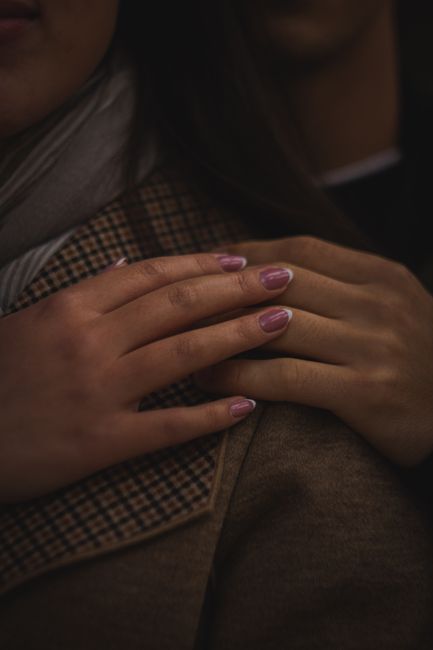
Photo by Ilyasick Photo via Pexels.
When you're picking a greeting card image, your eye probably defaults to the brightest one—a smiling face, clear light, easy to read. But sometimes the most intimate photographs are the ones that know when not to show everything.
A close-up of hands in near-darkness, where shadow becomes design rather than accident, says something that no expression ever could. There are no faces to interpret, no bright backgrounds demanding attention. Just two people in deep umber and almost-black, where the only color that breaks through is a single soft mauve on fingernails.
That teaches something worth remembering: closeness doesn't require an expression to prove itself. A hand resting on a shoulder, lit well enough to be seen but dim enough to feel private, can carry more weight than a wide-open, fully-legible moment. Sometimes what a photograph doesn't show—what it lets stay dark—is exactly what makes it feel caught rather than staged.