The Creator Economy Came for Design Too — Here's Why That Matters for Sending Something Lovely
Independent artist marketplaces have quietly grown into a real, high-volume purchase category. That shift in market infrastructure — not just a preference for handmade — is what makes buying a card from one named artist as easy as buying a mass-produced one.

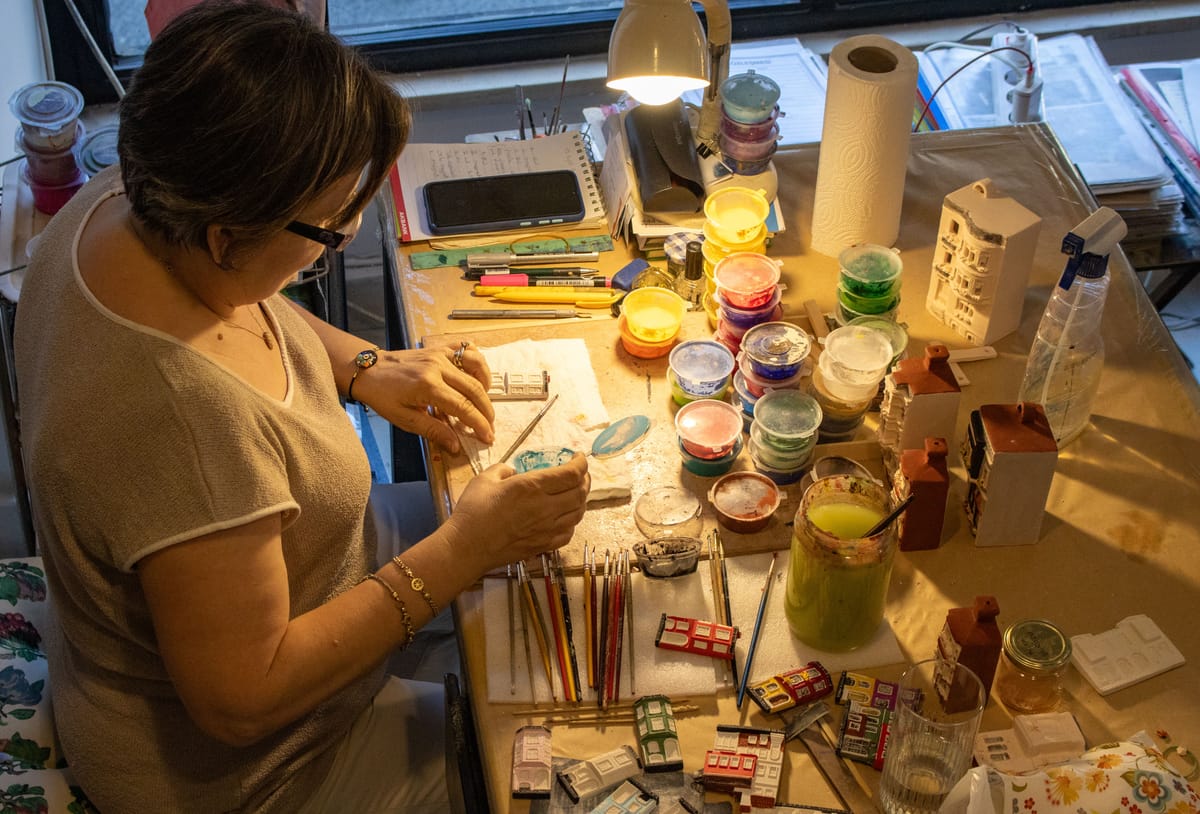
A decade ago, "buy from an independent artist instead of a big retailer" was mostly a moral stance — a nice idea that required real effort: finding a studio website, emailing about availability, waiting on a hand-cut check. Today it's closer to a default setting. You open a marketplace app, search a mood or a color instead of a brand name, and a working artist's piece ships the next day with tracking and a return policy. Nothing about the sentiment changed. The infrastructure underneath it did.
That infrastructure is the story worth telling — not because "people like handmade things" is news, but because the plumbing that makes independent, artist-made goods competitive with mass production at checkout is new, and it's growing fast enough to change what a design-and-gifting brand can credibly promise.
How big is the creator economy, actually?
Big enough that it's no longer a niche alongside traditional retail — it's becoming a parallel track through it. Independent estimates for 2026 put the global creator economy's total value in the low-to-mid hundreds of billions of dollars, with one widely cited figure landing around $313 billion, and direct fan/customer monetization (the part that routes money straight to an individual creator rather than through a label, publisher, or wholesaler) growing at roughly 31% year over year since 2024 as platforms built better tools for converting an audience into paying customers.
Zoom into the piece of that economy that looks most like a greeting card or design marketplace, and the numbers get concrete fast. Etsy alone reported roughly 86.5 million active buyers and 5.6 million active sellers, generating about $11.9 billion in gross merchandise sales in 2025 — the large majority of those sellers running one-person, home-based operations, not manufacturers. Redbubble, a print-on-demand marketplace built specifically for independent artists, has brought more than 700,000 designers onto a single platform where they upload artwork once and it prints on-demand across dozens of product types with no inventory risk. Society6 runs the same model at comparable scale.
None of that existed in its current form fifteen years ago. It isn't that people didn't want to buy from individual artists before — it's that no one had built the checkout, fulfillment, and discovery layer to make it as easy as buying from a factory. Now someone has, and it's carrying real transaction volume.
Why buyers are actually choosing it
Ease of access explains why independent-artist purchases are possible at this scale; it doesn't explain why people are choosing them when a cheaper, faster, more generic option usually sits one tab over. The preference itself shows up clearly in consumer research: the large majority of U.S. shoppers say they prefer buying from small or independent businesses when it's convenient to do so, and a solid majority are willing to pay a premium for it. The reasons people give aren't really about price — they're about story, specificity, and the sense that a real person made a real decision about this object, for reasons a shopper can actually understand.
| Mass-produced / licensed design model | Independent artist marketplace model | |
|---|---|---|
| Who gets paid | Manufacturer, licensor, retailer margin stack | Individual artist, directly, per sale |
| What you're buying | A design, replicated at volume | A specific person's specific piece |
| Discovery | Category, occasion, brand | Mood, style, the artist's own body of work |
| Story on the object | None — it's the same object everywhere | The artist's name, process, and other work are one click away |
| Buyer's stated reason | Price, convenience | Uniqueness, story, wanting to support a real maker |
That last row is the one worth sitting with. When people say they're tired of mass-produced sameness and want something with "a real story attached," they're not describing a quality judgment about craftsmanship — they're describing a relationship they want to have with the object before they even give it to someone else. A card someone picked because they found this artist's specific way of drawing light matters differently than a card pulled off a rack because it had the right holiday printed on the front.
Nugget: A gift's meaning often starts before it's given — in the moment of choosing it, when the giver decides this specific thing, made by this specific person, says something a generic option couldn't.
This is a different argument than "curation beats the algorithm"
It's worth being precise about what's new here versus what we've already covered. In an earlier piece on curated art versus algorithmic sameness, the case for a library of individual artists rested on psychology and AI research: people rate human-made work as more creative even when they can't tell it apart from a machine's, and generative models trained on their own output drift toward a narrower, more homogenous range over successive generations. That's an argument about why human-made variety is worth preferring.
This piece is about something adjacent but distinct: why that preference is now economically satisfiable at scale. It didn't used to be. A curated library of working artists used to mean a handful of names, limited availability, and real friction between wanting something specific and actually getting it. The creator economy's marketplace and fulfillment infrastructure — direct payment rails, print-on-demand production, searchable catalogs of individual creators' work — is what closed that gap. The psychology explains why curation is worth doing. The market infrastructure explains why it's finally viable to do at the volume a gifting platform actually needs.
What this means for how people send something lovely
For a store built around a curated library of illustrators, photographers, and animators rather than a wall of occasion-organized templates, this shift is tailwind, not novelty. It means the buyer standing in front of a screen trying to say something specific to someone specific isn't choosing between "artisanal and slow" or "generic and instant" anymore. Searching by mood, by color, by the feeling a piece gives off — the way a marketplace shopper already searches for a print for their wall — is becoming the normal way people expect to shop for meaning, not just decor.
Nugget: The easiest way to make a gift feel less generic isn't to add more customization options — it's to start from a specific artist's specific vision instead of a blank template.
FAQ
Is "creator economy" just a term for influencers and YouTubers? No — it's broader. It covers any model where an individual creator (a musician, illustrator, photographer, or designer) monetizes their work directly through a platform, rather than through a traditional label, publisher, or wholesale retail relationship. Marketplaces for physical and printed goods are a growing part of it, not a footnote.
Does buying from an independent artist marketplace cost more than a mass-market alternative? Sometimes modestly, sometimes not — print-on-demand production has closed much of the price gap that used to exist. Consumer research suggests most shoppers who prefer independent sellers aren't chasing the lowest price anyway; they're weighing story and specificity alongside cost.
Why does this matter for digital greeting cards specifically, if the products above are physical? The underlying shift is about how people find and value individually made design, which applies just as directly to a digital card as to a print or a mug. A curated library of named, findable artists is the digital-messaging equivalent of a marketplace stall — the medium changes; the reason someone chooses it doesn't.
The market has caught up to the sentiment. Buying something because one specific person made it is no longer the harder path — it's increasingly just the normal one.